
Decision-Making in AdTech: Rules vs Agentic Systems

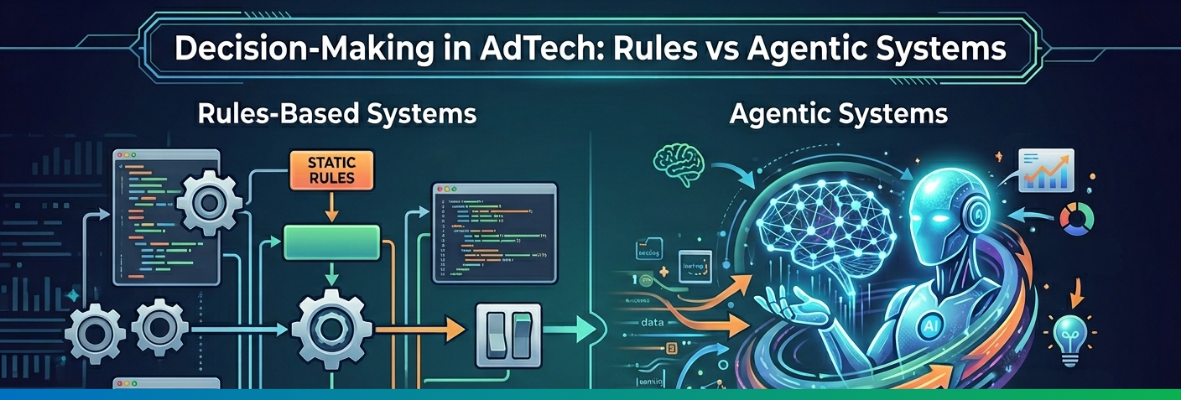
If you’ve spent any time in programmatic, you know the drill. Set your targeting rules, define your bid floors, schedule your optimisations, and hope the market behaves the way you planned.
That era is ending.
The shift from rules-based to agentic decision-making isn’t just a technology upgrade, it’s a fundamentally different philosophy of how advertising should work.
So what’s the difference, really?
Rules-based systems do exactly what you tell them. They’re predictable, controllable, and comfortable. But they’re also rigid. They can’t adapt to what they haven’t been programmed to expect.
Agentic systems, by contrast, are designed to reason and act toward goals, translating high-level intent into coordinated action across planning, activation, optimisation, and measurement. They don’t wait for instructions. They learn, adapt, and act.
Think of it this way: rules-based systems follow a recipe. Agentic systems know how to cook.
Why rules-based systems are hitting their limits
Traditional approaches relied on static, hand-tuned rules, fixed audience segments, line-item targeting, and scheduled bid adjustments. They worked when inventory, formats, and IDs were simpler, but they struggle with today’s volume, channel diversity, and auction dynamics.
Here’s where that shows up in practice:
- Slow reaction times – By the time a rule triggers, the opportunity has passed
- Budget inefficiency – Static floors and caps don’t account for real-time market shifts
- Fragmented decisions – Separate rules across channels create inconsistent outcomes
What agentic systems change
Unlike traditional AI, agentic AI operates autonomously, making complex decisions in real-time, dynamically optimising campaigns, and continuously improving performance, all without direct human input.
In practice, this means:
- Dynamic audience discovery – Audiences built in real-time from contextual signals, not predefined segments
- Continuous optimisation – Spend reallocated across channels and creatives based on live feedback, not scheduled check-ins
- Goal-based planning – Campaigns optimised toward outcomes, not just delivery metrics
The honest reality
Agentic AI is no longer hypothetical, but it is also not yet close to being the operating model of record. Measurement and attribution struggle to keep pace with autonomous action; feedback loops are often slow or incomplete, and governance gaps remain.
The teams winning right now aren’t abandoning human oversight entirely. They’re using agentic systems to handle the heavy lifting while keeping humans focused on strategy, creative direction, and goal-setting.
As agentic AI evolves, the focus shifts from simply having data to ensuring it’s usable. Marketers must audit their data, ensure cross-platform interoperability, and establish governance rules.
Where VoiseTech’s Voise Agentic Planner fits in
This is precisely the gap that VoiseTech’s Voise Agentic Planner is built to bridge. Designed for agencies and advertisers navigating the shift from rules to reasoning, it brings agentic decision-making into campaign planning, helping teams move faster, spend smarter, and optimise continuously without losing strategic control.
The rules served us well. But the market has moved on, and so should your decision-making stack.
Is your decision-making stack keeping up?
The shift from rules to reasoning is already underway. Whether you’re looking to reduce manual dependency or optimise across channels in real-time, VoiseTech’s Voise Agentic Planner is built to get you there.
Click the button below to get in touch with us today!

