
How AI Decisioning Is Replacing If-Then Logic in Programmatic

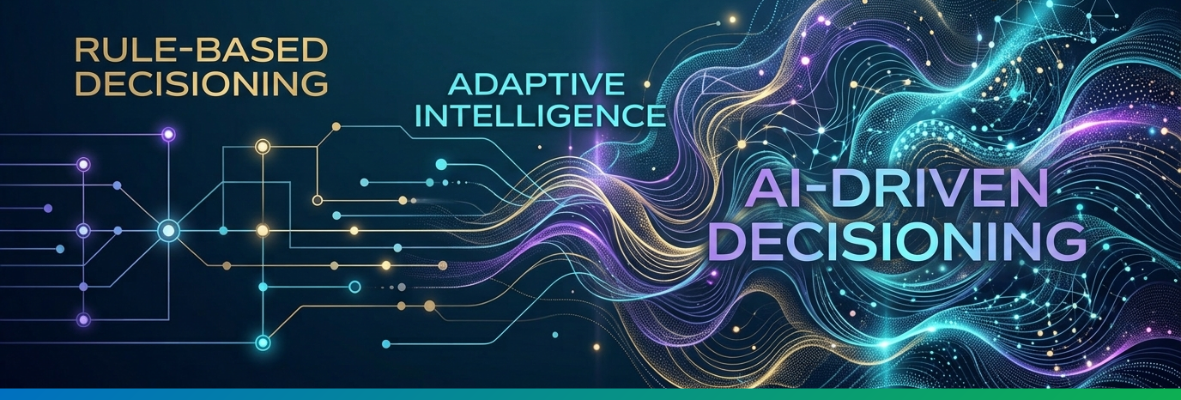
For years, digital advertising has worked on a simple principle: if this happens, do that. If an audience meets certain criteria, show an advert. If performance drops, adjust the budget. If a placement underperforms, reduce its priority. This approach made advertising more predictable, but today’s media environment is moving too quickly for fixed instructions to keep up.
The shift is already visible. Global advertising investment surpassed $1 trillion in 2025, while dentsu expects it to grow another 5.0% in 2026. More than four-fifths of digital investment is expected to be programmatic this year.
From Fixed Rules to Continuous Decisions
Traditional rules are designed around situations people expect in advance. AI decisioning works differently. Instead of waiting for a predefined condition, it can assess multiple signals, recognise changing patterns and recommend or take the next action based on the campaign objective.
This matters because a modern campaign can run across websites, mobile, connected TV, audio and other digital environments at the same time. What works in one market, format or moment may not work in another.
The scale of this change is significant. In its January 2026 outlook, the IAB found that two-thirds of buyers were focused on agentic AI for advertising buying and campaign execution. The same study found that five of the six areas where advertisers planned to increase focus were directly connected to AI.
Why the Change Matters Now
The biggest advantage of AI decisioning is not simply speed. It is the ability to make decisions continuously.
Consider a campaign targeting several countries. A fixed system may apply the same instructions across every market. An AI-led approach can assess what is happening across different audiences and environments, then adjust its recommendations as conditions change.
That becomes increasingly important as advertising budgets grow more complex. WARC’s research found that 59% of marketers are concerned about AI disruption, while 76% already use AI to summarise large amounts of information.
The wider shift towards AI-led decision-making is also happening beyond advertising. Research from WARC estimates that more than $944 billion in global consumer spending will be facilitated by AI agents in 2026, showing how quickly AI is becoming part of everyday decision-making.
AI Does Not Mean Removing People
Replacing fixed rules does not mean removing human judgement. The stronger model is collaboration. People define the business objective, brand boundaries and desired outcomes. AI can then help process information, identify opportunities and adjust decisions at a scale that would be difficult to manage manually.
That distinction is important as adoption grows. AI should make decision-making more responsive without making it less understandable or accountable.
Where VoiseTech Fits
For global advertisers and agencies, this is where an integrated approach becomes valuable. VoiseTech’s Agentic Planner helps teams move from a campaign brief to a media plan, while Voise AudienceIQ brings first-party, contextual and multicultural audience signals into the planning process. Voise DSP and Voise Curation extend that intelligence into campaign activation and curated media buying. Together, these capabilities reflect a broader shift from fixed instructions towards smarter, more responsive decision-making across markets and channels.
The question is no longer whether advertising decisions can be automated. It is whether they can become intelligent enough to adapt to what is happening next.
Ready to move beyond fixed rules? Let’s talk to explore AI-led planning, audience intelligence and advertising infrastructure built for a changing global media landscape.

