
Buying Direct vs. Programmatic: A Strategic Framework for Modern Media Investment

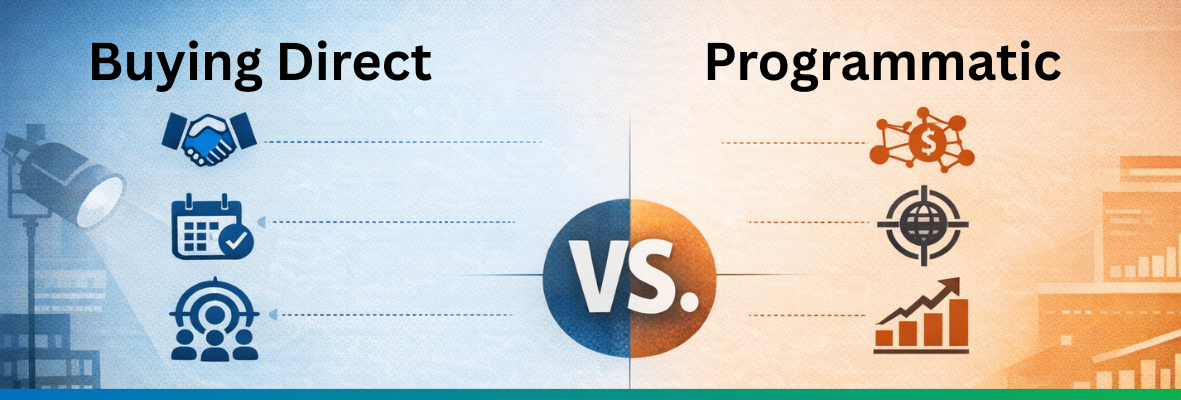
For years, the advertising industry framed media buying as a choice between direct publisher negotiations and automated programmatic transactions. That binary perspective no longer reflects the scale, complexity, or maturity of the global advertising ecosystem.
According to a 2025 projection reported by The Wall Street Journal, global advertising expenditure is expected to exceed $1.14 trillion, driven by sustained digital acceleration, connected TV expansion, and AI-enabled optimisation. At this level of scale, the question is no longer whether to buy direct or programmatically. The real question is how to structure investment strategically.
Programmatic Buying: The Dominant Global Infrastructure
Programmatic buying has evolved from an efficiency tool into the backbone of global digital advertising. Industry projections indicate that over 82% of global digital ad spend in 2025 will transact programmatically, representing roughly $651 billion flowing through automated systems. By 2026, programmatic is forecasted to account for around 90% of global digital display ad spending, underscoring the depth of automation in modern media trading.
Data referenced in the IAB Internet Advertising Revenue Report 2024 further shows that automation now dominates digital display environments across display, video, mobile, and connected TV.
Programmatic delivers:
- Real-time bidding and dynamic optimisation
- Data-driven audience precision
- Cross-channel scalability
- Performance tracking at the impression level
For performance-driven campaigns and measurable ROI mandates, these capabilities offer speed and efficiency that direct-only models cannot replicate at scale. However, automation alone does not guarantee quality. Supply path complexity, invalid traffic (IVT), and opaque fee structures remain structural challenges.
Direct Buying: Strategic Control and Premium Positioning
Despite automation’s dominance, direct buying continues to play a strategic role in global media investment. It has not disappeared; it has evolved.
The 2024 Internet Advertising Revenue Report by IAB indicates that approximately 39% of programmatic revenue originates from private marketplace (PMP) and direct-style arrangements, highlighting sustained demand for curated inventory within automated ecosystems.
Direct buying provides:
- Guaranteed placements
- Premium sponsorship integrations
- High-impact creative formats
- Contextual alignment
- Enhanced brand safety control
For reputation-sensitive industries or major product launches, these attributes justify premium CPMs. Direct relationships also enable custom integrations that open exchanges cannot replicate. The trade-off is reduced flexibility and often a higher cost relative to open programmatic environments.
A Framework Based on Objectives, Not Ideology
Modern advertisers no longer treat direct and programmatic as competing philosophies; they allocate investment based on specific business outcomes.
Programmatic buying excels at driving performance and scale. By utilizing Open Exchange and PMP inventory through dynamic, real-time bidding, it is the optimal choice for ROI-driven campaigns, broad reach, and retargeting. This data-driven approach ensures high efficiency across standard display and video units.
Conversely, Direct buying prioritizes brand equity and impact. It secures guaranteed placements and sponsorships at fixed, negotiated rates, making it ideal for high-profile launches and prestige positioning. This method ensures deep contextual alignment and supports high-impact, custom creative units that automation cannot always replicate.
In practice, sophisticated advertisers operate a hybrid model: leveraging programmatic infrastructure for scalable performance while using curated, direct environments to build long-term brand authority.
The Infrastructure Layer: The True Differentiator
The future of media investment is less about the buying channel and more about the infrastructure that governs it. Supply path optimisation (SPO), AI-driven bid decisioning, and advanced IVT filtration now determine whether media budgets translate into business outcomes.
VoiseTech addresses this through:
- Intelligent Supply Path Architecture: Reducing middle-man fees.
- Cross-Channel Transparency: Unified views across CTV, Web, In-App, and DOOH.
- Advanced IVT Mitigation: Frameworks designed to protect performance at scale.
Conclusion
The debate between direct and programmatic is outdated. Modern media strategy is about aligning buying methods with business outcomes and strengthening the infrastructure that connects demand and supply. In a trillion-dollar advertising economy, strategic allocation and transparent execution are no longer advantages; they are requirements.

