
The Convergence of CTV, Mobile and Web

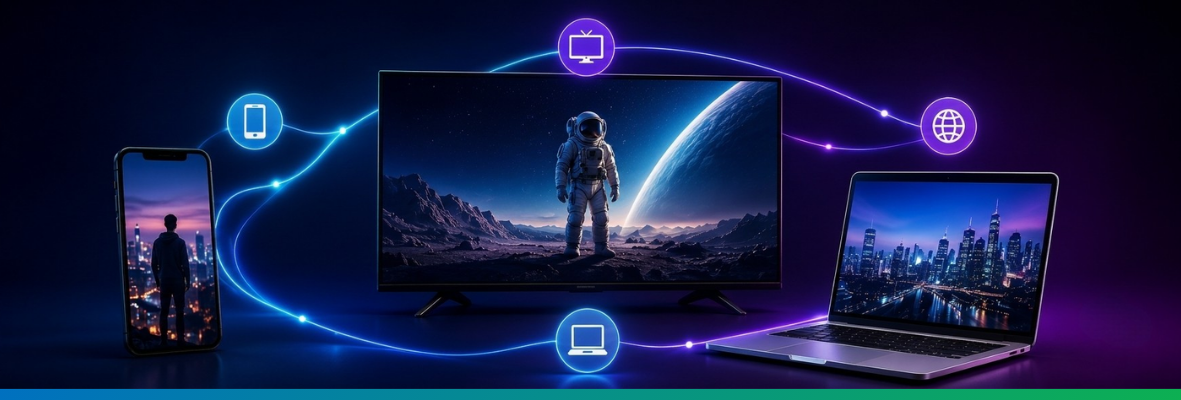
Quick question: when was the last time you watched something on your TV without having your phone in hand?
Exactly. Nobody does. And that one habit is quietly rewriting the rules of advertising.
Audiences stopped thinking in “channels” a long time ago. Today, they move from the living room TV to a phone to a laptop tab, often within the same five minutes, without giving it a second thought. The problem? Most ad tech stacks are still built like CTV, mobile, and web are three strangers who’ve never met. That gap is exactly where 2026’s biggest opportunity and challenge lives.
Why This Convergence Is the Big Story Right Now
- Moments over channels: A majority of audiences now move fluidly between CTV and mobile during the same viewing session, yet most marketers are still running separate audience strategies for each screen.
- Measurement is the real challenge: A large share of marketers say the lack of unified measurement across platforms is the single biggest barrier to cross-channel success, not creative, budget, or targeting.
- Data infrastructure decides who wins: Recent industry research shows that only a small fraction of marketers consider their ad tech stack fully connected across channels like CTV, social, and display, which makes infrastructure readiness more important than any single feature.
- AI is orchestrating, not just reporting: Agentic systems are starting to perceive a situation, reason through it, and take action toward an objective, deciding in real time whether a person should see your message on the big screen, the small screen, or the browser next.
- Infrastructure-first companies are pulling ahead: As ecosystems converge, identity, delivery, and measurement are merging into single systems rather than living across five disconnected vendors.
In short: the audience converged years ago. The infrastructure is still catching up.
Where VoiseTech Fits In
This is precisely the gap Voise Ad Server was built to solve.
Instead of bolting together separate tools for separate screens, Voise Ad Server runs as one unified infrastructure layer with:
- Built-in CMS and player capabilities that deliver consistent ad experiences whether the screen is a TV, a phone, or a browser.
- AI-enhanced decisioning that adapts in real time across formats, instead of running CTV, mobile, and web on separate logic.
- Clean, unified supply routing, so the same transparency standard applies whether the impression served is on a streaming app or a mobile feed.
- Transparent, cross-screen measurement, so “how did this campaign actually perform” has one honest answer instead of three conflicting ones.
Convergence doesn’t have to mean complexity. It just needs infrastructure that was actually designed for it, not infrastructure that’s bolting screens together after the fact.
What This Means for You
The brands and publishers who win in this next phase won’t be the ones running the most channels; instead, they’ll be the ones running them as one coordinated system.
If your stack still treats CTV, mobile, and web like strangers at a networking event, it’s worth a conversation.

